Father's Day 2026
18th June 2026
This Father's Day, let's take a look at how you can track down the male ancestors who might be missing from your family tree.

It’s worth mentioning before we begin that we might cover some emotionally tricky subjects in this post, relating to fatherhood and paternity. If you think it might be a tough read right now, please go ahead and close this post, you are always welcome to come back for the next one.
Anyone who has undertaken any level of family history research can understand the frustration of coming up against what has been called a “brick wall” by genealogists. There’s the thrill of chasing down a family line, finding parents and children through your records search when, all of a sudden, everything stops. Someone isn’t in the census for a particular year, yet there’s no death record, or even no birth records.
Questions over paternity can make brick walls even harder to break through, if a mother didn’t disclose or know the name of their baby’s father.
Now that DNA tests are so widely available, they can be invaluable tools to help track down more elusive relatives.
Hunting with Haplogroups
If you’re biologically male, you’re likely to have a Y chromosome. The genetic material held in this chromosome is passed down from a father to all of his sons, completely unchanged over many generations. In most western naming conventions, fathers pass their surname on to their children, which means that the surname follows the Y chromosome.

When you have your DNA tested with Living DNA, we always include Y-DNA testing (for genetic males). Once you’ve identified a potential relative, try tracing their descendents and see if there are any living males that have come through the male line. If their Y haplogroup matches up with your own, it’s an indication that you’re related!
There are drawbacks to using Y-DNA to find a genetic relationship. For example, you may not be related to a match through the ancestor you’re investigating, but through someone who lived hundreds or even thousands of years before. Also, as genetically female individuals don't generally inherit a Y chromosome, if any ancestors in the chain leading to either you or the descendent of your potential relative are a mother or great grandmother, the Y-DNA haplogroup passed on will be from the father or grandfather from that generation, and therefore useless in your search.
Autosomal DNA matching
Another useful tool for breaking through paternal brick walls can be autosomal DNA matching.
Once you have some candidates for an unknown father in your family tree, and have traced out a couple of promising leads to their modern-day descendants, you can find out if you appear in one another’s match lists at the right level.
For example, let’s imagine you’re looking for a great-grandfather. You have identified through census information and speaking to living relatives that your great-grandmother, Maude, was working for a man named John, and her parents had a lodger named Andrew. She left her job around the time of her pregnancy, and the lodger moved out at the same time. Either of these events could be explained by the pregnancy, or by there being a relationship breakdown.
You’ve traced both John’s and Andrew’s family trees and found that John has a living great-grandson, and Andrew has a living great-granddaughter.

You carefully and tactfully reach out to both the great-grandson and the great-granddaughter, and ask if they have taken a DNA test anywhere. They both say yes, and agree to upload their raw data to Living DNA, free of charge. Once all three of you have your match results, you check your match list and see that Andrew’s great-granddaughter has appeared in your list as a 3rd - 5th cousin and John doesn’t appear at all. Congratulations, you have identified your great-grandfather Andrew!
As you will find with any scientific process, there are limitations to what DNA can tell you.
You get 50% of your autosomal DNA from each of your parents - half from your mum and half from your dad - and the 50% you receive from each parent is made from an entirely random selection of their own DNA. Some segments of each of your grandparents’ DNA might be overrepresented, while others might be underrepresented or even missing altogether. This is perfectly normal and is part of what makes genetic inheritance so complex and fascinating.
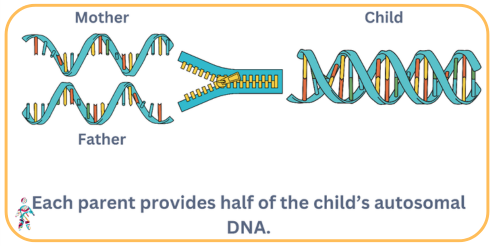
You can read more about recombination on our blog, here, but it essentially means that while you have 64 ancestors at the 6th generation back, you might not have inherited any detectable DNA from some of them.
Tracking down the paperwork
But how do you get to the point where you’re ready to test John and Andrew’s descendants in the first place? How do you find co-workers, lodgers, neighbours, family friends?
The answer isn’t easy, and it can take time and effort to achieve your goal, but it’s always possible. A single line in a single document can be enough to break down the wall to find your lost ancestor.
The “FAN” club
The "FAN club" means the Friends, Associates, and Neighbors of your ancestor. They did not live in a vacuum, and would have had people around them, just like we do today. You might not find them in an obvious place like in the same house or on a census, either. Families appearing as witnesses on marriage certificates, co-signers of land deeds, or families living in the same neighbourhood on the census.
Occupational networks can be key when searching for an unknown father, especially as men were often identified by their trade. When you’re looking for links, check for witnesses or apprentices sharing the same occupation, as this can indicate a father-son relationship or a master-apprentice dynamic that can reveal a father’s identify.
You might find those tantalising clues, like a maiden name or a place of origin, that are missing from your target ancestor’s own records.
Beyond the Transcript
While it can be faster to just look at the online transcripts of documents you’re researching, they can be prone to transcription errors, so try to track down the original record if you can. Physical microfilm or scanned images of probate records, tax rolls, church registers, and land deeds can often contain little details you haven’t been able to find in the transcript or summary.
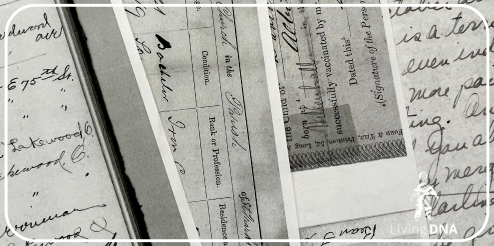
You may be able to find the names you’re researching in apprenticeship indentures, or guild records. In some cases they contain key details about the father’s name, residence or trade.
Collateral Lines
Take a break from frustrating dead ends and try looking at your direct ancestor’s siblings, even their extended family. You may find a sibling’s records contain names, dates, or locations to help nail down the names of their parents. Obituaries can vary wildly between siblings in the amount of information given, and can be a valuable resource for little details that are overlooked elsewhere.
Contextualise the History
Take a step back from focussing on individuals, and instead take a look at what was happening in the wider region at the time your ancestor lived. Was there a decline in the industry your ancestor specialised in? Was there a war or a famine? Could they have moved away, or sent their children somewhere new?
Military records can provide clues about relocations - was your ancestor stationed elsewhere within the country, or even overseas? Muster rolls, pension records, and service files might even include physical descriptions and records of who their next-of-kin were.

Other historical events can lead to missing links in your research. For example, in England it became practice from the 1600s to send poor or orphaned children overseas, primarily as a form of cheap labour. They began by sending children to America, but by the 1800s, Canada and Australia saw the most children immigrating. If your ancestor suddenly appears in the country as a child with no other family between 1600 and 1970, consider looking at ships records from the time.
Comparative Timelines
Lay out every event you know of from your ancestor’s life in a timeline. Make sure you include regional migration patterns you’ve researched, as well as property acquisitions and tax payments you’ve been able to identify.
Work records and career milestones can be useful in tracing men from your tree. Find out where your ancestor was listed as an apprentice, a journeyman, or a master, any year they paid land tax, or joined a guild.
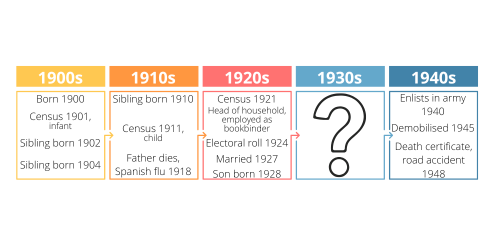
When you lay it all out visually, it makes any gaps more obvious and could lead you to find a period of time when they moved away or married.
Naming Traditions
In many cultures, and even within some families, naming traditions can be very strict - such as a first son being named after their paternal grandfather. If you’ve identified a pattern within your own family tree, and you find a man who fits that pattern along with a number of other clues, you may well have found your ancestor.

It's time to get started!
Whether you’re just starting to peel back the layers of your family tree or you’ve been staring at a brick wall for years, remember that every name and date you uncover brings you closer to the story of the men who shaped your lineage. Unraveling these paternal threads can be a way of honouring the unique history that connects you to your past.
This Father’s Day, why not give the gift of discovery? If you're ready to turn those questions into answers, our test is the perfect starting point to help you or the father figure in your life to finally map out that family story.