Understanding your Motherline and Fatherline results
2nd September 2026
Learn more about your Motherline and Fatherline, and how the results can differ from your Recent Ancestry.
Interpreting your Motherline and Fatherline Results
When you first receive your ancestry results, it’s tempting to rush in and explore, but there’s a lot of information there to digest and it can get overwhelming quite quickly, leaving you with more questions than answers.

A big one we get a lot at Living DNA is “Why don’t my Motherline and Fatherline results match my Recent Ancestry, or even my parents’ known ancestry?” It’s a great question, and one that’s important to understand before you go further in your ancestry research.
Instead of pinpointing your parents’ personal history, your motherline and fatherline will show you regions where you can find people who share a common ancestor with you. The connection through this common ancestor might be relatively recent, or it could stretch back thousands of years.
Your motherline is based on a piece of DNA called 'mitochondrial DNA' (mtDNA for short), and you inherited it from your mother, who inherited it from her mother and so on. Male children will always inherit their mother's mtDNA but cannot pass it on to their own children.
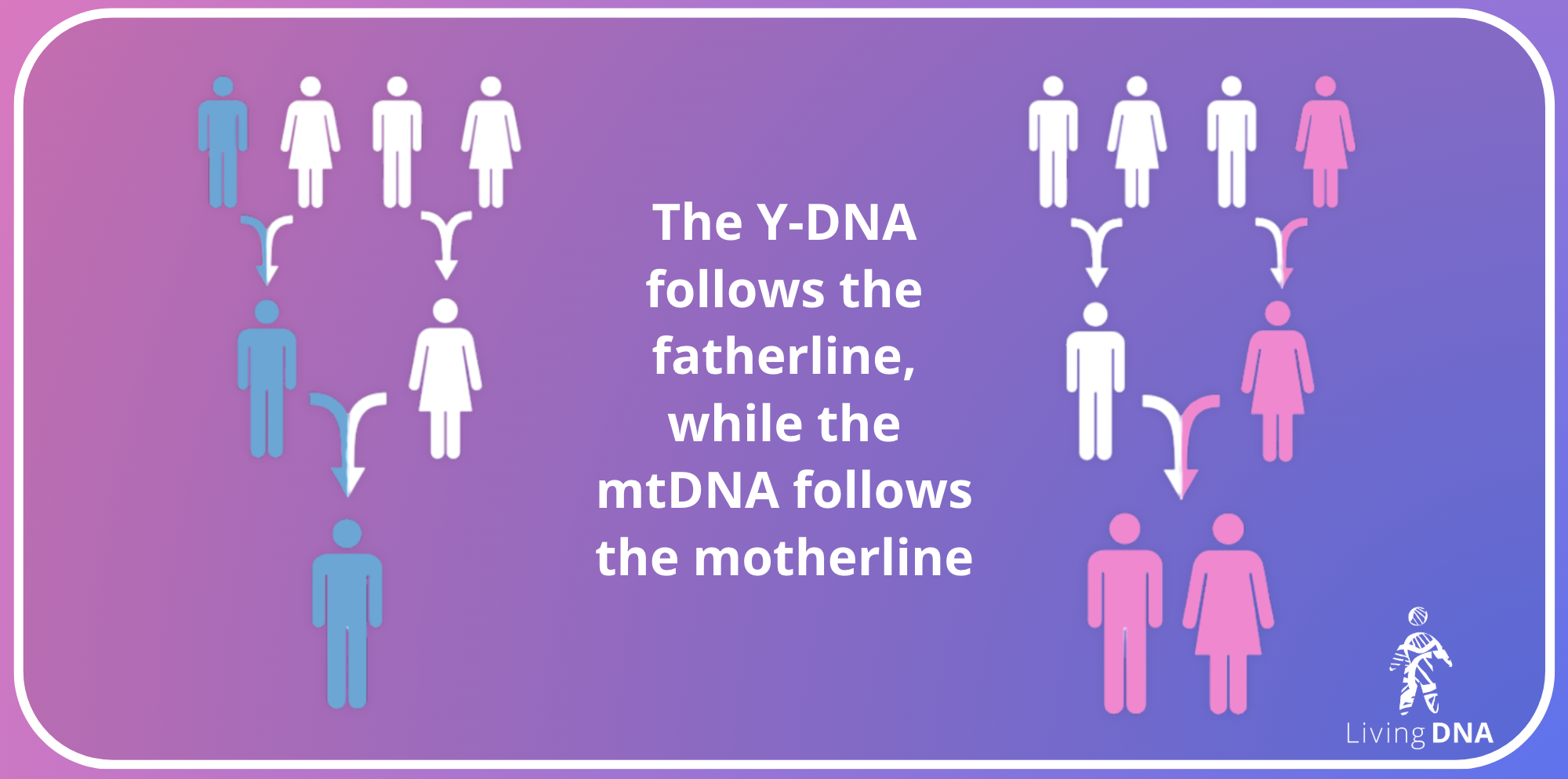
Your fatherline is based on a different piece of DNA that is passed from a father to all of his sons. It's found on the Y chromosome, so genetically female children don't inherit it at all. This is why we can't provide fatherline results to genetically female customers.
Understanding haplogroups and haplotypes
To understand the motherline and fatherline results, you need to know two key terms: haplotype and haplogroup.
Your haplotype is your unique genetic signature. Think of it like a single leaf on a massive tree. Your haplogroup is the specific branch that your leaf belongs to, representing a larger group of people who share the same broad ancient signature, but have different individual haplotypes.

You still share a common ancestor with everyone in your haplogroup, but much further back in time than the haplotype ancestor. This relative may have lived tens of thousands of years ago, before any records began, so while we can’t identify any precise details about them, they are still your link to an ancient past.
Exploring the Distribution Map
The Distribution Map of your motherline and fatherline is a powerful tool that shows where specific haplogroups are found today. Because genetic testing can identify these groups, researchers use this data in academic studies to trace the ancient migrations of early humans across the globe.
It is vital to remember that the percentages on your Distribution Map show where your haplogroup is most prevalent; they do not represent how much of your personal DNA comes from a specific population. For instance, if your map shows "England 10%," it simply means that 10% of people tested in England share your haplogroup.
Because these are independent frequencies, your motherline and fatherline percentages will only very rarely add up to exactly 100%.
It’s also very common for your Distribution Map to differ widely from your Recent Ancestry, as it’s looking at a very different timeframe.
Imagine a woman living in what is now Türkiye, twenty thousand years ago. She doesn’t know it, but when she was conceived the DNA in her mitochondria mutated ever so slightly, and she is the first ever person to carry a brand new haplotype.
She passes it on to her children like an heirloom. The boys can’t pass it on, but the girls pass their mother’s new haplogroup on to the next generation, who will grow up to eventually pass it on to the next as well.
Maybe, after 5 thousand years, just one woman descended from that first originator of the haplogroup might have settled in a small, wet, and rainy town on a small, wet, and rainy island, and had one daughter, who also had one daughter, who also had one daughter. If their fathers over every successive generation are all local men, then after a number of generations there’s no physical clues to any ancestry from Türkiye, and over thousands of years there’s no written record that it exists either.
Eventually, the small wet and rainy town becomes a city, and with small numbers of daughters surviving to pass on that haplotype over tens of thousands of years, the haplotype exists in a very small number of people living in modern-day England. It might be so rare that fewer than 1% of people in England carry it, but it’s still there.
When a descendent of that woman sees their Living DNA results, they’re confused - their Recent Ancestry results show that they’re 100% English, but they have 50% Türkiye on their motherline, but this can be a completely normal, even expected result.
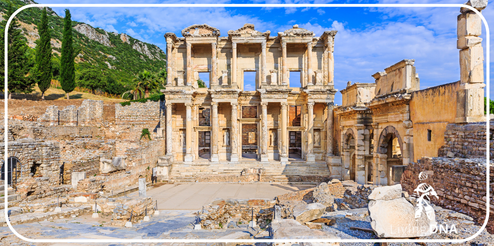
All because, 20,000 years ago, their maternal ancestors had lots of successful daughters, and now 50% of people in Türkiye carry the same haplogroup.
Mapping the journey
The Migration Map offers a theoretical look at the route your ancient ancestors may have taken from Africa to the present day.
This is just one of many possible paths your lineage could have followed over hundreds of generations, based on genetic, archaeological, and anthropological research.
At various points along the journey, new haplotypes will have emerged. The major ones in your haplotype’s lineage have been plotted on the route, and you can click on each one to read about your even more ancient ancestors.
The root of it all
The ROOT on your Migration Map is the Most Recent Common Ancestor (MRCA) on either the maternal or the paternal line of every human alive today.
The haplogroups change slightly over time, with new haplotypes arising due to tiny mutations within individuals. This allows geneticists to trace different lineages, tracking population movements through these genetic mutations that are prevalent in different groups of people. Eventually, if you trace these different mitochondrial lineages back through time far enough, you find that they all converge onto one ‘source’ of mitochondrial DNA - Mitochondrial Eve.
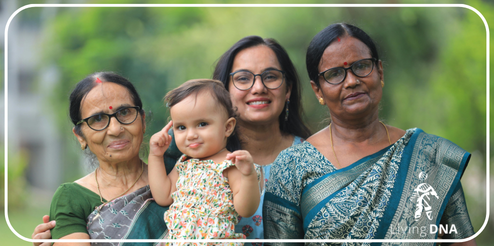
The concept of a Mitochondrial Eve relies on the idea that some human lineages will be more successful than others. In a certain generation, some females will have many daughters, whilst some will have few or none. Again in the next generation, some females will have many daughters, and some will have few or none. If a female has many daughters, who each go on to have a lot of daughters, and those daughters also have a lot of daughters, then the motherline from that one female will become more and more prevalent within the group. Over tens of thousands of years, one particular motherline may become so successful that it is the only one remaining. This is what has happened in human beings. Somewhere between 100,000 and 230,000 years ago, a female lived. Through our mothers, and their mothers, and their mothers, every person on this planet can trace their motherline back to this one individual.
Y Chromosomal Adam works in much the same way. Eventually, by tracing different Y-DNA lineages back through time far enough, you find that they all converge onto one 'source' of Y chromosomal DNA: Y Chromosomal Adam.